Industrial Automation Solution with AI: Transforming Manufacturing for a Smarter Future
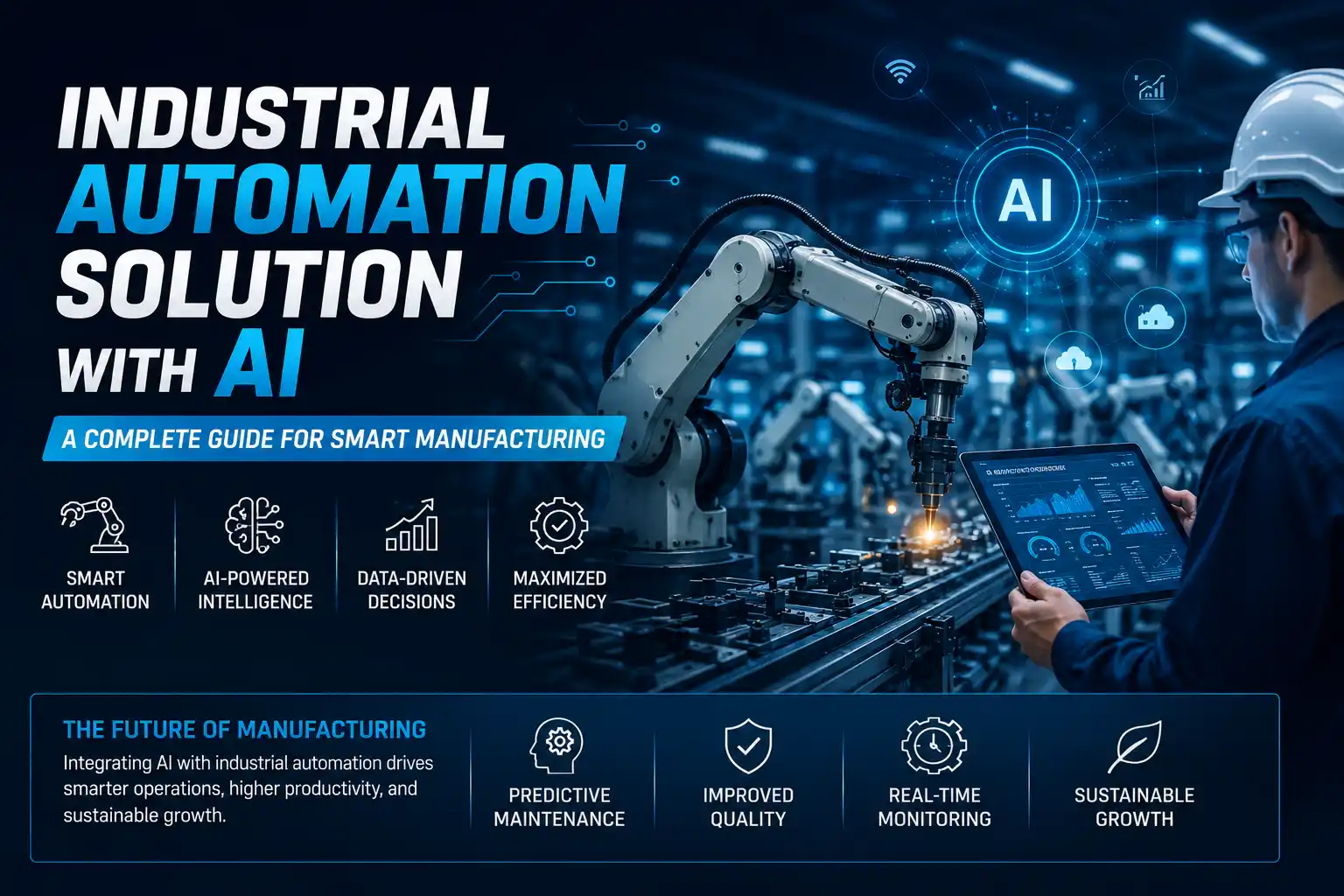
Manufacturing is changing faster than ever. Rising production demands, tighter quality standards, skilled-labor challenges, and the need to control operating costs are pushing manufacturers to rethink how their factories operate.
Traditional automation has already transformed production by introducing PLCs, robotics, sensors, servo systems, machine vision, and automated material handling. But the next stage of this evolution is making these systems more intelligent.
This is where AI-powered industrial automation is becoming increasingly important.
Artificial intelligence can help manufacturing systems identify patterns, predict equipment problems, detect defects, optimize processes, and support faster operational decisions. Instead of automation simply following predefined instructions, an intelligent system can use production data to understand what is happening and help determine what should happen next.
At Leaptech, we see AI not as a replacement for proven automation technologies, but as an intelligence layer that can make existing industrial automation solutions more productive, responsive, and data-driven.
What Is an Industrial Automation Solution with AI?
An industrial Automation Solution with AI combines conventional automation technologies with artificial intelligence and machine-learning capabilities.
Traditional automation generally works according to predefined logic:
If X happens → perform Y.
This approach remains essential for deterministic machine control, safety sequences, motion control, and repeatable manufacturing operations.
AI adds another layer of intelligence:
Analyze data → identify a pattern → predict an outcome → recommend or initiate an appropriate action.
For example, a conventional automated machine can monitor the temperature of a motor. An AI-enabled system can analyze temperature, vibration, operating cycles, current consumption, and historical maintenance information to identify whether the equipment is showing early signs of abnormal behavior.
This combination creates a more intelligent manufacturing environment.
An AI-driven industrial automation solution can integrate technologies such as:
- PLC and HMI systems
- Industrial robotics
- Machine vision
- Sensors and IIoT devices
- SCADA and MES platforms
- Predictive analytics
- Machine-learning models
- Edge computing
- Data acquisition systems
- Automated inspection systems
- Industrial communication networks
The objective is not simply to “add AI” to a factory. The real objective is to solve measurable manufacturing problems using the right combination of automation, data, and intelligence.
Why AI Is Becoming Important in Industrial Automation
Manufacturing machines generate enormous amounts of information every day.
Temperature, pressure, vibration, cycle time, motor current, machine speed, inspection results, production quantities, downtime events, and quality parameters can all provide valuable insights.
However, collecting data is only the beginning.
The challenge is turning that data into useful decisions.
AI can analyze large and complex datasets much faster than conventional manual analysis. It can identify relationships that may not be immediately visible to operators and engineers.
For manufacturers, this can translate into several practical benefits:
1. Reduced Unplanned Downtime
Unexpected machine failure can interrupt production, delay deliveries, and increase maintenance costs.
With AI-enabled predictive maintenance, equipment data can be continuously analyzed to identify unusual patterns that may indicate developing problems.
For example, changes in vibration or motor current could indicate wear or abnormal machine behavior.
Instead of waiting for a component to fail, maintenance teams can receive an early warning and plan corrective action during a suitable production window.
This makes predictive maintenance one of the most practical applications of AI in industrial automation.
2. Improved Quality Inspection
Quality inspection is another area where AI can create significant value.
Traditional inspection processes can depend heavily on manual operators or rule-based machine vision. While these approaches remain valuable, AI-powered vision systems can identify complex visual patterns and classify defects based on trained models.
An AI-enabled inspection system can potentially identify:
- Surface defects
- Incorrect component placement
- Assembly errors
- Dimensional variations
- Missing components
- Soldering defects
- Scratches and marks
- Product inconsistencies
For electronics and automotive manufacturers, where quality requirements are particularly demanding, AI-powered inspection can help improve consistency while reducing dependence on repetitive manual inspection.
The important point is that inspection intelligence should be connected to the manufacturing workflow. Detecting a defect is only useful when the system can trigger the appropriate action, such as rejection, rework, traceability, or operator notification.
3. Intelligent Process Optimization
Manufacturing processes often involve dozens of parameters.
Temperature, pressure, speed, torque, cycle time, feed rate, and other variables can influence productivity and product quality.
An AI-enabled industrial automation system can analyze historical and real-time production data to identify relationships between process parameters and outcomes.
This can help manufacturers answer questions such as:
- Which parameters are affecting product quality?
- Why is cycle time increasing?
- What conditions are associated with higher rejection rates?
- Which machine settings produce better process stability?
- Where is production efficiency being lost?
Instead of relying entirely on trial and error, production teams can use data-driven insights to improve process performance.
4. AI-Based Anomaly Detection
Not every machine failure follows the same pattern.
In many production environments, failures are relatively rare, which means there may not be enough historical examples to train a conventional failure-prediction model.
Anomaly detection provides another approach.
AI can learn what normal machine behavior looks like by analyzing historical operating data. When the system detects a significant deviation from the normal pattern, it can generate an alert.
This can be particularly useful for:
- Motors
- Pumps
- Compressors
- Conveyors
- Robotic systems
- Assembly equipment
- Production lines
- Industrial machinery
The result is faster identification of unusual behavior before it develops into a larger production issue.
5. Smarter Industrial Robotics
Robotics has been a fundamental part of industrial automation for decades.
Robots are already used for assembly, welding, material handling, pick-and-place, dispensing, inspection, and other repetitive operations.
AI can make robotic systems more adaptable.
By combining robotics with machine vision, sensors, and intelligent software, robots can respond to changing production conditions instead of operating only within highly predictable environments.
For example, an AI-enabled vision system can help a robot identify the position and orientation of components before performing an assembly operation.
This creates opportunities for more flexible manufacturing, particularly where product variants and production requirements change frequently.
AI and Machine Vision: A Powerful Combination
Machine vision has become an important component of modern industrial automation systems.
A conventional vision system can compare images against predefined rules. AI-based vision can take this further by learning from examples and identifying complex visual characteristics.
Consider an electronics assembly line.
A traditional automated inspection system may check whether a component exists in a predefined position. An AI-powered vision system can potentially analyze additional characteristics and identify subtle variations that may be difficult to define through conventional rules.
This is particularly valuable in applications where products have multiple variations or where defect types are difficult to describe using simple inspection criteria.
At Leaptech, integrating automation with inspection, sensing, and intelligent decision-making can help manufacturers build a more connected approach to quality control.
How AI Fits into an Existing Industrial Automation System
One common misconception is that manufacturers need to replace their existing automation infrastructure before implementing AI.
That is not necessarily the case.
A practical industrial Automation Solution can build on existing infrastructure.
A typical architecture may include:
Machine & Sensors → PLC → SCADA/HMI → Data Layer → AI Analytics → Decision/Workflow
The PLC and control system continue handling deterministic machine operations and safety-related sequences.
AI can operate above this control layer, analyzing information and providing predictions, recommendations, or alerts.
For example:
Sensors collect machine data.
↓
PLC/Control System manages machine operation.
↓
SCADA/MES/Data Platform stores and contextualizes production information.
↓
AI Model analyzes patterns.
↓
AI Output provides an alert, prediction, classification, or recommendation.
↓
Operator/Automation Workflow takes the appropriate action.
This layered approach allows manufacturers to introduce intelligence without unnecessarily disrupting established automation architecture.
Edge AI vs Cloud AI in Industrial Automation
Another important consideration is where AI processing should take place.
Edge AI
Edge computing processes data close to the machine or production line.
It can be useful when applications require:
- Low response times
- Local decision-making
- Reliable operation even with limited connectivity
- Reduced data transfer
- Real-time inspection or machine monitoring
For example, an AI-based vision inspection application may require image analysis within a fraction of a second. Processing locally can help minimize latency.
Cloud AI
Cloud platforms can be useful for:
- Centralized analytics
- Historical data analysis
- Model training
- Multi-site monitoring
- Enterprise reporting
- Long-term data storage
In many industrial environments, a hybrid approach can provide the best balance.
Real-time AI inference can happen near the machine, while centralized platforms can support analytics, reporting, and model management.
How to Implement an AI-Powered Industrial Automation Solution
AI implementation should start with a manufacturing problem—not with the technology.
At Leaptech, a practical approach begins by understanding the application, equipment, process requirements, and desired business outcome.
Step 1: Identify the Manufacturing Challenge
Start with a measurable problem.
For example:
- Reduce machine downtime
- Improve inspection accuracy
- Reduce rejection rates
- Increase production throughput
- Improve equipment utilization
- Reduce manual intervention
A clearly defined objective makes it easier to determine whether AI is actually appropriate.
Step 2: Evaluate Available Data
AI needs reliable data.
Manufacturers should evaluate what information is already available from PLCs, sensors, machines, SCADA systems, inspection equipment, MES platforms, and other sources.
Data quality matters.
Incorrect timestamps, inconsistent machine tags, missing information, and poorly defined quality records can reduce the effectiveness of AI models.
Step 3: Select the Right AI Application
Not every manufacturing problem requires advanced AI.
Predictive maintenance may be appropriate for a critical machine experiencing unexpected failures.
Computer vision may be suitable for repetitive quality inspection.
Anomaly detection may make sense when unusual machine behavior is difficult to identify manually.
The technology should follow the problem.
Step 4: Start with a Controlled Pilot
Instead of immediately implementing AI across an entire factory, manufacturers can begin with one machine, one process, or one inspection point.
A controlled pilot allows teams to measure:
- Accuracy
- Response time
- Downtime reduction
- Quality improvement
- Operator acceptance
- Return on investment
Step 5: Integrate AI with the Production Workflow
An AI model should not exist as an isolated dashboard.
Its output should connect to the actual manufacturing process.
For example, an inspection model could automatically communicate a defect classification to the production system, while a predictive maintenance system could generate an alert for the maintenance team.
This is where engineering integration becomes critical.
Step 6: Monitor and Improve
Manufacturing environments continuously change.
New products, different materials, machine wear, process changes, and sensor variations can influence AI performance.
Therefore, AI systems should be monitored and periodically improved.
AI implementation should be treated as an ongoing engineering process rather than a one-time software installation.
The Role of Leaptech in AI-Enabled Industrial Automation
At Leaptech, we believe successful automation is about more than installing machines.
It is about understanding the manufacturing process and engineering a solution around the customer's actual production requirements.
Our approach to industrial Automation Solution development focuses on combining automation engineering with technologies such as PLC/HMI systems, robotics, machine vision, servo motion, sensing, inspection, material handling, process monitoring, and data integration.
AI can add another level of intelligence to this ecosystem.
For example, an automated production line can be designed to collect process information, monitor machine conditions, perform automated inspection, and generate actionable production insights.
This approach is particularly relevant for industries such as:
- Automotive manufacturing
- Electronics manufacturing
- Semiconductor manufacturing
- PCB assembly
- Industrial equipment manufacturing
- High-volume production environments
The goal is not to replace proven industrial automation with AI. The goal is to make automation smarter where intelligence can create measurable value.
What Is the Future of AI in Industrial Automation?
The future of manufacturing will likely be defined by greater collaboration between humans, machines, robotics, data, and AI.
Factories will increasingly move from reactive operations toward predictive and intelligent systems.
Instead of simply reporting that a machine has stopped, future systems will increasingly focus on understanding why performance is changing.
Instead of identifying a defective product after production, intelligent inspection systems can help detect quality issues earlier.
Instead of relying only on fixed maintenance schedules, manufacturers can increasingly use equipment data to make maintenance decisions based on actual machine condition.
Edge computing, industrial connectivity, machine vision, robotics, predictive analytics, and AI will continue to converge as manufacturers build smarter production environments.
However, successful implementation will depend on more than AI algorithms.
Reliable automation architecture, high-quality data, cybersecurity, machine integration, operator acceptance, and measurable ROI will remain equally important.
Final Thoughts
AI is changing the way manufacturers think about automation.
But the biggest opportunity is not simply putting artificial intelligence into a factory. It is creating an integrated industrial Automation Solution where automation performs reliably, machines communicate effectively, data is converted into useful intelligence, and people can make better decisions.
For manufacturers considering AI, the best starting point is usually a clearly defined operational challenge—whether that is downtime, quality, productivity, inspection, or process variability.
From there, AI can be introduced gradually, validated against real production requirements, and scaled when it demonstrates measurable value.
At Leaptech, our focus is on engineering practical automation solutions that help manufacturers move toward more connected, intelligent, and efficient production.
Ready to explore how AI can improve your manufacturing process? Connect with Leaptech to discuss an industrial automation solution designed around your production requirements.