Semiconductor Assembly Equipment: Types, Applications, Working, Cost, and How to Choose the Right System
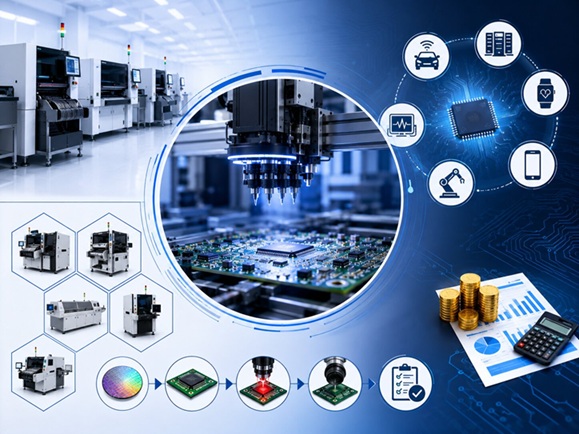
The semiconductor industry is moving faster than ever. As electronic devices become smaller, smarter, and more powerful, semiconductor manufacturers are under constant pressure to improve production efficiency, maintain quality, and reduce manufacturing costs.
At the heart of this process is semiconductor assembly equipment.
From die bonding and wire bonding to advanced packaging, inspection, and testing, the right equipment can have a direct impact on product quality, production throughput, and long-term operational efficiency. However, choosing the right equipment is not always straightforward. Different semiconductor packages require different processes, levels of automation, accuracy, and handling capabilities.
At Leaptech, we understand that semiconductor and electronics manufacturing is not simply about purchasing a machine. It is about creating a reliable automation solution that fits your process, production goals, and future requirements.
In this guide, we explore what semiconductor assembly equipment is, how it works, the major equipment types, applications, automation levels, cost considerations, and the factors manufacturers should evaluate before investing.
What Is Semiconductor Assembly Equipment?
Semiconductor assembly equipment refers to the machines, systems, and automated solutions used to assemble semiconductor devices after wafer fabrication and during the packaging stage.
Once semiconductor wafers have been fabricated and individual dies are prepared, they need to be assembled and packaged so they can be integrated into electronic products. This involves several precise operations, including:
- Die placement and bonding
- Flip chip attachment
- Wire bonding
- Encapsulation and molding
- Package assembly
- Inspection
- Testing
- Material handling
Semiconductor assembly equipment is designed to perform these operations with a high level of precision, repeatability, speed, and process control.
Depending on the application, equipment can range from manually operated systems to sophisticated, fully automated production lines integrated with robotics, machine vision, motion control, and factory automation systems.
What Is Semiconductor Assembly?
Semiconductor assembly is the manufacturing process in which an individual semiconductor die is connected, protected, and packaged for use in an electronic device.
The process typically begins after wafer fabrication and dicing. The individual semiconductor dies are then assembled into packages that provide:
- Electrical connections between the semiconductor die and the outside world.
- Mechanical protection against physical damage.
- Thermal management to help dissipate heat.
- Reliability during the semiconductor device's operating life.
The exact assembly process depends on the type of semiconductor and package being manufactured.
For example, a traditional package may use die attach and wire bonding, while advanced semiconductor packages may rely on flip chip technology, advanced substrate integration, or other high-density packaging techniques.
Because semiconductor assembly involves extremely small components and tight tolerances, equipment accuracy and process consistency are critical.
Why Semiconductor Assembly Equipment Is Important
Modern semiconductor manufacturing requires more than simply assembling components. Manufacturers must achieve consistent quality at increasingly high production volumes.
This is where semiconductor assembly equipment becomes essential.
- Improved Precision: Semiconductor devices often involve extremely small components and precise placement requirements. Automated equipment can control movement and positioning with a high degree of repeatability.
- Higher Production Throughput : Automation can perform repetitive assembly operations significantly faster than manual processes, helping manufacturers increase production capacity.
- Consistent Quality : Automated systems reduce variations caused by manual handling and provide more consistent process results.
- Reduced Manufacturing Errors : Integrated sensors, machine vision, and process monitoring can help identify positioning or assembly issues earlier.
- Better Traceability : Modern equipment can be integrated with manufacturing execution systems (MES), databases, and production monitoring platforms to improve process traceability.
- Improved Worker Safety and Ergonomics : Automation can reduce the need for operators to perform repetitive or highly precise tasks manually.
- Scalability : A well-designed automation solution can provide a foundation for future production expansion, additional product variants, and increased demand.
For semiconductor manufacturers, the goal is not simply to automate everything. The goal is to automate the right processes in the right way.
Types of Semiconductor Assembly Equipment
Semiconductor assembly includes multiple processes, and each requires specialized equipment.
The major categories include die bonding equipment, flip chip bonding equipment, wire bonding equipment, encapsulation and molding systems, packaging equipment, and inspection and testing systems.
Let's look at each in more detail.
Die Bonding Equipment
Die bonding equipment, also known as die attach equipment, is used to place and attach semiconductor dies onto a substrate, lead frame, package, or other mounting surface.
The die must be positioned accurately before being attached using an appropriate bonding method or adhesive.
Depending on the application, die bonding may involve:
- Epoxy adhesive
- Solder
- Conductive adhesive
- Eutectic bonding
- Other specialized attachment technologies
A typical die bonding system may include:
- Wafer handling
- Die picking
- Vision alignment
- Precision motion systems
- Die placement
- Adhesive dispensing
- Bonding mechanisms
Accuracy is especially important because incorrect die placement can affect electrical performance, thermal characteristics, and downstream packaging processes.
For manufacturers producing high volumes, automated die bonding systems can help improve throughput while maintaining consistent placement accuracy.
Flip Chip Bonding Equipment
Flip chip bonding is an advanced semiconductor assembly technique in which the semiconductor die is flipped upside down and connected directly to the substrate through bumps or other interconnect structures.
Unlike traditional wire bonding, flip chip technology does not require wires between the die and package substrate.
Flip chip bonding equipment typically performs:
- Die pickup
- Alignment
- Vision inspection
- Precision placement
- Bonding
- Reflow or other joining processes, depending on the technology
The technology is widely used where compact designs, high electrical performance, and high-density interconnections are important.
Because alignment requirements can be extremely demanding, flip chip equipment often relies heavily on precision motion control and advanced machine vision.
Wire Bonding Equipment
Wire bonding is one of the most established semiconductor interconnection technologies.
In this process, fine wires are used to electrically connect the semiconductor die to the package leads or substrate.
Common wire bonding technologies include:
- Ball bonding
- Wedge bonding
The choice depends on factors such as package design, wire material, device requirements, and production process.
Wire bonding equipment must provide accurate movement and consistent bonding force to create reliable electrical connections.
Important equipment considerations include:
- Bonding accuracy
- Bonding speed
- Wire handling
- Process repeatability
- Material compatibility
- Quality monitoring
For high-volume production, automated wire bonding equipment can deliver significant improvements in productivity and process consistency compared with manual operations.
Encapsulation and Molding Equipment
After the semiconductor die and interconnections are assembled, the device may need to be protected from environmental and mechanical damage.
Encapsulation and molding equipment helps protect semiconductor components by enclosing them in a protective material.
Depending on the package and process, this may involve:
- Transfer molding
- Compression molding
- Epoxy encapsulation
- Other protective materials and processes
The equipment must carefully control parameters such as:
- Material quantity
- Temperature
- Pressure
- Curing conditions
- Cycle time
Consistent molding is important because defects such as voids, incomplete filling, or material inconsistencies can affect package reliability.
Packaging Equipment
Semiconductor packaging equipment covers a broad range of systems used to complete and prepare semiconductor devices for final use.
Depending on the product, packaging processes may include:
- Package assembly
- Lead forming
- Trimming
- Singulation
- Marking
- Labeling
- Tape and reel packaging
- Tray loading
- Material handling
Automation can connect these processes into a coordinated production workflow.
For high-volume semiconductor operations, automated material handling and package transfer systems can be particularly valuable in reducing manual intervention and improving production flow.
Inspection and Testing Equipment
No semiconductor assembly process is complete without inspection and testing.
Inspection and testing equipment helps manufacturers identify defects before products move to the next manufacturing stage or reach customers.
Common technologies include:
- Machine vision inspection
- Optical inspection
- Dimensional inspection
- Electrical testing
- Functional testing
- Automated test systems
Machine vision is increasingly important in automated semiconductor assembly. Vision systems can inspect component placement, alignment, surface conditions, and other quality characteristics.
The goal is simple: detect problems as early as possible.
When inspection is integrated directly into an automated production line, manufacturers can potentially reduce scrap, improve traceability, and respond more quickly to process deviations.
How Semiconductor Assembly Equipment Works
While the exact process varies depending on the semiconductor package, a typical automated assembly workflow may look like this:
Step 1: Material Loading
Semiconductor dies, substrates, lead frames, or other components are loaded into the equipment.
Step 2: Component Identification
The system identifies and verifies the incoming material using sensors, vision systems, barcodes, or other identification methods.
Step 3: Precision Positioning
Robotic mechanisms or precision motion stages move components into the correct position.
Step 4: Alignment
Machine vision or other sensing technologies verify the position and orientation of components.
Step 5: Assembly or Bonding
The system performs the required process, such as die bonding, flip chip bonding, or wire bonding.
Step 6: Inspection
The assembled component is inspected to verify process quality.
Step 7: Handling and Transfer
The completed assembly is transferred to the next process through automated handling systems.
Step 8: Data Collection
Production and quality data may be collected and stored for traceability and process analysis.
In a modern automated production environment, these steps can be connected through a combination of PLC controls, robotics, servo motion systems, machine vision, sensors, HMIs, and industrial communication networks.
This is where automation engineering becomes especially important.
A machine may perform a specific operation extremely well, but the real production advantage often comes from integrating the entire process into a reliable and coordinated system.
Applications Across Semiconductor Packaging
Semiconductor assembly equipment is used across a wide range of packaging and electronic manufacturing applications.
Some common areas include:
Consumer Electronics : Smartphones, tablets, laptops, wearables, and other consumer products require compact and reliable semiconductor packages.
Automotive Electronics : Automotive applications demand high reliability and robust manufacturing processes. Semiconductor devices are used in areas such as vehicle control systems, sensors, power electronics, and advanced driver assistance systems.
Industrial Electronics : Industrial automation, robotics, control systems, and monitoring equipment depend on reliable semiconductor components.
Power Semiconductors : Power semiconductor packages require careful attention to thermal management, electrical performance, and mechanical reliability.
Communication and Networking : High-performance communication equipment requires semiconductor packages capable of supporting demanding electrical and thermal requirements.
Medical Electronics : Medical devices often require highly reliable electronic components manufactured under strict quality requirements.
Across these industries, the right assembly equipment depends heavily on the package type, production volume, required accuracy, and quality standards.
Manual vs. Semi-Automatic vs. Fully Automatic Equipment
One of the most important decisions when planning semiconductor assembly automation is determining the appropriate level of automation.
Manual Equipment
Manual equipment in semiconductor assembly requires operators to perform key tasks such as component placement, die handling, bonding, or inspection.
It is best suited for low-volume production, prototyping, and applications requiring greater flexibility. Manual processes rely heavily on operators for material handling and assembly activities.
Advantages:
- Lower initial investment
- Suitable for low-volume production
- Flexible for prototypes and product development
- Easy to modify for changing requirements
Limitations:
- Higher dependence on operator skill
- Lower throughput
- Greater process variation
- Limited scalability
Manual processes may be suitable for laboratories, prototypes, development work, or very low-volume manufacturing.
Semi-Automatic Equipment
Semi-automatic equipment combines automated processes with operator involvement for tasks such as loading, positioning, or inspection.
It offers better productivity and consistency than manual equipment while maintaining flexibility for low- to medium-volume production. Semi-automatic systems combine automated process steps with operator intervention.
Advantages:
- Better productivity than manual processes
- More consistent results
- Moderate investment
- Greater flexibility
This approach can be a practical option for manufacturers transitioning from manual production toward greater automation.
Fully Automatic Equipment
Fully automatic equipment performs semiconductor assembly processes with minimal operator intervention, using automation, robotics, and control systems.
It provides high throughput, consistent quality, improved efficiency, and greater scalability for high-volume production.
Fully automated systems integrate material handling, processing, inspection, and data collection with minimal operator intervention.
Advantages:
- High throughput
- Consistent production
- Reduced manual handling
- Better process monitoring
- Improved scalability
- Greater traceability potential
However, fully automated systems typically require a higher initial investment and more detailed engineering.
The right choice depends on production volume, product complexity, labor availability, quality requirements, and long-term business goals.
How to Choose Semiconductor Assembly Equipment
Choosing semiconductor assembly equipment is not simply about finding the machine with the highest speed or the lowest price. The equipment should be selected based on the complete manufacturing process.
Before making a decision, manufacturers should consider:
- What semiconductor package are you producing?
- What is the required production volume?
- What level of precision is required?
- What materials will the equipment handle?
- What is the expected cycle time?
- How much flexibility is required?
- What quality standards must be met?
- How will the equipment integrate with existing systems?
- What level of automation is appropriate?
- What are the maintenance and service requirements?
A detailed process evaluation can prevent an expensive mistake later.
Key Factors to Consider When Choosing Semiconductor Assembly Equipment
When choosing semiconductor assembly equipment, manufacturers should focus on five important factors: accuracy, throughput, reliability, flexibility, and cost. These factors help ensure that the equipment performs efficiently and provides good long-term value.
1. Accuracy
Accuracy means how precisely the machine can place and assemble semiconductor components. Good equipment should provide accurate placement, consistent results, reliable vision systems, and precise motion control.
2. Throughput
Throughput refers to how many products the equipment can process in a specific time. A good machine should offer fast cycle times, minimal downtime, quick changeovers, and efficient material handling.
3. Reliability
Reliability means how consistently the equipment can operate without unexpected breakdowns. Consider equipment quality, maintenance needs, spare parts availability, technical support, and downtime.
4. Flexibility
Flexibility means the equipment can adapt to different products and changing production needs. Flexible systems can handle different package types, component sizes, product changeovers, and future upgrades.
5. Cost
Cost includes more than the initial purchase price. You should also consider installation, integration, training, maintenance, energy use, spare parts, software, and future upgrades. The cheapest equipment is not always the most cost-effective choice in the long run.
Semiconductor Assembly Equipment Cost and ROI
The cost of semiconductor assembly equipment can vary significantly.
A simple manual workstation may require a relatively modest investment, while a highly customized, fully automated production line with robotics, machine vision, precision motion control, and integrated inspection can represent a much larger capital investment.
The final cost depends on factors such as:
- Equipment type
- Automation level
- Production volume
- Required accuracy
- Customization
- Machine vision requirements
- Robotics
- Inspection systems
- Software integration
- Data traceability
- Safety requirements
- Installation and commissioning
Instead of looking only at the purchase price, manufacturers should calculate the total cost of ownership (TCO) and expected return on investment.
A basic ROI calculation may consider:
ROI = (Annual Financial Benefit − Annual Operating Cost) ÷ Initial Investment
Potential benefits can include:
- Increased production capacity
- Reduced labor requirements
- Lower scrap rates
- Improved quality
- Reduced downtime
- Faster cycle times
- Better traceability
For example, a more expensive automated solution may provide better long-term value if it significantly improves throughput and reduces production losses.
The key is to evaluate the investment over its expected operating life—not just the initial purchase price.
Common Questions About Semiconductor Assembly Equipment
What is semiconductor assembly equipment used for?
Semiconductor assembly equipment is used to perform processes such as die bonding, flip chip bonding, wire bonding, encapsulation, packaging, inspection, testing, and material handling.
What is the difference between semiconductor assembly and semiconductor packaging?
The terms are often used interchangeably, but semiconductor assembly generally refers to the processes involved in assembling the semiconductor die and its interconnections, while packaging encompasses the broader process of creating the final protective and functional package.
Is semiconductor assembly equipment always fully automated?
No. Equipment can be manual, semi-automatic, or fully automatic. The right level depends on production volume, budget, quality requirements, and process complexity.
How important is machine vision in semiconductor assembly?
Machine vision can be highly valuable for component identification, alignment, placement verification, and quality inspection. Its importance depends on the precision and inspection requirements of the application.
How long does semiconductor assembly equipment last?
The service life varies depending on equipment design, operating conditions, maintenance, usage, and technology changes. A well-maintained system can remain productive for many years, although software, controls, and specific components may require upgrades over time.
Should I buy standard equipment or invest in a custom automation solution?
Standard equipment may be suitable when your process closely matches an established machine configuration. Custom automation can be more appropriate when you have unique process requirements, specialized handling needs, or a need to integrate multiple operations into one system.
How to Select a Semiconductor Assembly Equipment Manufacturer
Selecting the right equipment manufacturer is just as important as selecting the equipment itself. A reliable partner should understand both the technology and your manufacturing objectives.
If you are looking for a semiconductor equipment supplier for manufacturing automation consider the following terms:
Industry Experience: Look for a company with experience in semiconductor, electronics, or precision automation applications.
Engineering Capability : A strong engineering team should be able to understand your process and develop an appropriate solution rather than simply selling standard equipment.
Automation Expertise : Automation expertise is most important facts to fulfil demand on time, evaluate experience in:
- PLC programming
- Robotics
- Servo motion control
- Machine vision
- HMI development
- Industrial communication
- Data acquisition
- MES integration
Customization : Your semiconductor equipment provider should be capable of adapting the system to your specific production requirements.
Integration Capability : If you already have manufacturing equipment, the new system should be capable of integrating with your existing production environment.
After-Sales Support : After sales support is a valuable facts for every supplier. So consider these terms:
- Installation
- Commissioning
- Training
- Preventive maintenance
- Troubleshooting
- Spare parts
- Technical support
Long-Term Partnership : The best equipment supplier is not necessarily the company that offers the cheapest quotation. It is the partner that can support your operation throughout the equipment's lifecycle.
Why Work With Leaptech for Semiconductor Automation?
At Leaptech, we believe automation should solve real manufacturing challenges—not simply add technology for the sake of technology.
As an automation service provider serving electronic automation industries, we focus on developing practical and reliable automation solutions that help manufacturers improve production efficiency, consistency, and process control.
Our approach can include areas such as:
- Industrial automation
- Machine automation
- PLC and HMI systems
- Robotics integration
- Servo and motion control
- Machine vision
- Automated material handling
- Process monitoring
- Production data integration
- Custom automation solutions
Every manufacturing process is different. That is why we believe the right solution starts with understanding your application, production requirements, and long-term goals.
Whether you are looking to automate a single semiconductor assembly operation or develop a more comprehensive production automation solution, the right engineering approach can make a significant difference.
Final Thoughts for Semiconductor Equipment Supplier
Semiconductor assembly equipment plays a critical role in converting semiconductor dies into reliable, functional packages ready for integration into electronic products.
From die bonding and flip chip bonding to wire bonding, molding, packaging, inspection, and testing, every stage requires careful consideration of precision, throughput, reliability, flexibility, and cost.
The right equipment is not necessarily the most expensive or the most automated. It is the solution that best matches your process requirements today while providing a practical path for future growth.
For manufacturers planning a new semiconductor assembly project or looking to improve an existing production line, working with an experienced automation partner can help turn complex manufacturing requirements into a reliable and scalable solution.
Looking for the Right Semiconductor Assembly Automation Solution?
If you are evaluating semiconductor assembly equipment, planning a new automation project, or looking to upgrade your existing production process, Leaptech can help you explore the right approach for your application.
Talk to our automation specialists to discuss your requirements, production goals, and equipment needs.
Request a Quote or Contact Leaptech Today to start a conversation about your semiconductor and electronics automation project.